
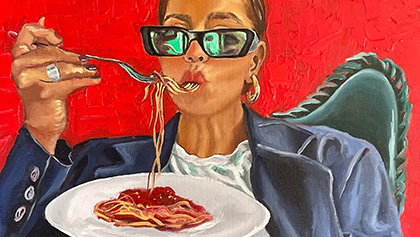
From Feeding to Feeling: Rediscovering the Body Through Eating, Fasting, and Cultural Transition
Reading Richard Shusterman’s “Somaesthetics and the Fine Art of Eating” and Yanping Gao’s “Taking Tea, but Differently” made me notice how much of life passes through the body without conscious attention. Both essays show that eating, drinking, and even the small gestures of everyday life carry deep cultural meaning. As I reflected on the arguments in these texts, I began to recognize how my own body has been a site of transformation and learning, especially through the years I struggled with weight gain after immigrating to the United States and then later through my long-term practice of intermittent fasting. These personal experiences reshaped how I understand the somaesthetic ideas that both authors explore.
Shusterman’s idea that eating is a temporal and performative activity affected me strongly. He explains that eating unfolds through sequences of sensing, chewing, breathing, swallowing, pausing, and noticing. These are highly organized somatic actions, yet most of us rush through them. This insight made me think about how differently I experienced food during different stages of my life. For many years, eating for me was an act driven by pleasure, stress, culture, and sometimes simply convenience. When I first arrived in the United States as a graduate student, I lacked familiarity with the food culture. I was surrounded by fast food, processed snacks, and cheap options that were abundant and often low in nutritional quality. Without realizing it, my habits changed. I began eating larger portions, eating late, eating fast, and relying on foods that my body was not accustomed to. This shift was not simply a lack of discipline. It was a cultural transition. I was moving from an Iranian food environment with more structured meals, shared dishes, and slower rhythms into a context where eating was fragmented, individual, and often rushed. This slow accumulation of habits caused a gradual weight gain that became part of the background of my life.
Years later, during and after COVID, I made a decision to understand my body more intentionally. Through intermittent fasting, combined with careful attention to my diet, I lost about seventy pounds, although some of it returned later as my routines changed. But the numbers were not what mattered. What felt transformative was the profound awareness I gained of my own somatic rhythms. During fasting, I noticed bodily sensations I had never been conscious of before. The hours without food turned into a laboratory of somaesthetic experience. I could feel how my energy shifted at different stages. After about ten hours of fasting, my body changed its pace. Hunger signals appeared like waves. At twelve to fourteen hours, my mind became unexpectedly sharp and focused. I realized this clarity was connected to metabolic processes, such as the early stages of ketosis and the hormonal adjustments the body makes when it believes it must stay alert to survive without food. In those long windows of non-eating, I learned to sense my breathing, my posture, the tension and relaxation of my muscles, and even the emotional fluctuations that accompany hunger. It was not only eating that became aesthetic and mindful, but also the absence of eating. Fasting became a daily somatic practice that taught me the intelligence of my own metabolism.
This experience gave me a new way to understand Shusterman’s idea that mindful attention reveals the aesthetic dimension of ordinary actions. He argues that the pleasure of eating depends on awareness, rhythm, and bodily coordination. I found that fasting introduced a contrast that sharpened my senses when I finally ate. After twenty hours of not eating, one small bite of food carried an intensity that I could not recall feeling before. The flavor, texture, and temperature were magnified. It was as if the body, after a long silence, suddenly spoke loudly. This somatic contrast made Shusterman’s ideas feel very real for me. Eating became meaningful because non-eating made me aware of what my body truly needed. In this way, fasting taught me a discipline that resembles what Shusterman describes as somaesthetic training. The body becomes a site of learning, refinement, and self-understanding.
Gao’s essay on tea deepened this reflection by showing how cultural environments shape these bodily rhythms. In China, she explains, tea is presented in small porcelain cups without handles. The drink is consumed slowly, often surrounded by natural materials, silence, and a contemplative atmosphere. The entire sensory world around tea highlights mindfulness. In Britain, however, tea was transformed into an indoor performance filled with silver trays, patterned porcelain, and social activity. Milk and sugar were added. Conversation and entertainment became central. The vessel and the surrounding space changed the entire meaning of the drink.
This cultural contrast reminded me of my own shifting relationship to tea. In Iran, tea is more than a drink. It has its own rhythm and its own somatic expectations. The thin glass warms the fingertips. The aroma rises gently. You hold it close to your face. There is no sugar unless you choose a small piece to place on your tongue. The tea slows you down. It becomes a moment of grounding. When I first drank tea in American offices, served in thick ceramic cups or disposable paper cups, the experience felt different. The material, the temperature, the gesture, and even the social atmosphere transformed the meaning of the drink. Reading Gao helped me understand that this difference was not trivial. It was a cultural change that altered my bodily awareness without me realizing it.
Both authors helped me see that immigration is not just a movement across borders. It is a movement across somatic expectations. One culture trains a body to sit, move, eat, and sense in certain ways, while another culture trains it differently. My early years in the United States were shaped by unfamiliar food environments, irregular schedules, and a sense of cultural dislocation. My body reflected this confusion. Later, when I began fasting and studying my metabolism, I became more attentive not only to food but also to the cultural habits around food. I realized that my Iranian rhythms still existed inside me, and they offered a sense of balance that had been disrupted. Their reappearance through mindful eating and fasting allowed me to reconnect with parts of myself that I had lost without noticing.
In both essays, I found a reminder that design is not only about objects or visual elements. It is also about the design of actions and the design of the body’s relationship to its environment. Eating, drinking, fasting, walking, breathing, and even waiting become aesthetic forms when approached with awareness. This connects deeply with my research as a designer and artist. My work often explores how visual culture shapes identity, memory, and belonging. These readings helped me recognize that the body itself is part of that cultural design. A meal, a cup of tea, or even a moment of hunger can become a site of reflection and meaning.
By combining the theoretical insights of Shusterman and Gao with my own lived experiences, I now see somaesthetics not as an abstract philosophy but as a practical guide for understanding how culture, habit, and awareness shape the body. Eating can be an art when it is mindful. Not eating can also reveal unexpected layers of bodily intelligence. Tea can be a moment of connection across cultures or a symbol of cultural transformation. These texts helped me rediscover the depth hidden in ordinary actions and reminded me that the body, when listened to carefully, becomes a teacher.
Diana Torres
Rassa id neque aliquam vestibulum morbi blandit in fermentum et sollicitudin ac orci phasellus egestas tellus velit ut tortor pretium viverra suspendisse potenti nullam ac tortor eu turpis egestas pretium.
David Jonson
Massa id neque aliquam vestibulum morbi blandit in fermentum et sollicitudin ac orci phasellus egestas tellus velit ut tortor pretium viverra suspend isset.