
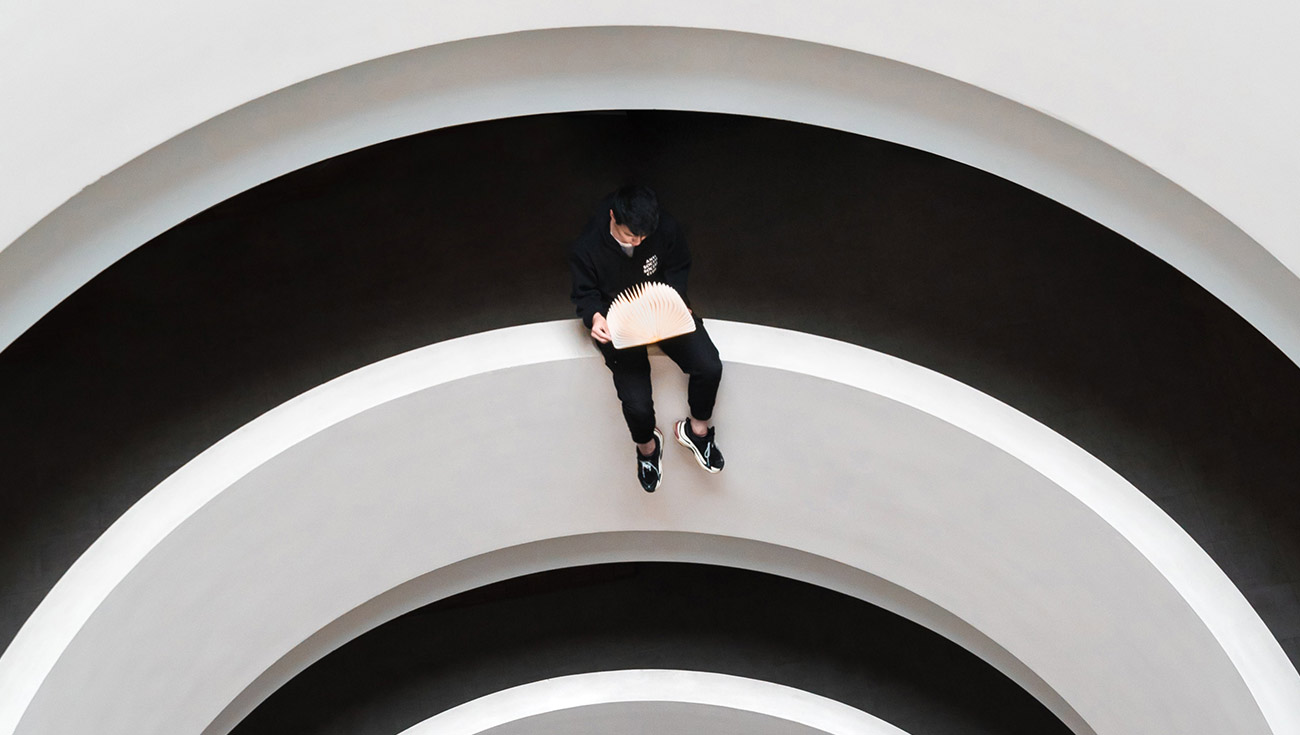
Where Does Atmosphere Live?
A reflection on Simmel, Scully, and somaesthetic experience
If I’m honest, this seminar in aesthetics is harder for me to write in than my philosophy class. In philosophy, I can immediately locate myself: my immigrant story, the friction between languages, the long commute between cultures. In aesthetics, I’m learning a new vocabulary for things I’ve long felt in my work but didn’t yet know how to name. So I’m writing as a student who is still learning, testing ideas against my experiences, and resisting the temptation to end with a grand conclusion. The central question I want to hold throughout this reflection is simple and difficult: Where does atmosphere live—and can we intentionally shape it without killing it?
Simmel’s “Philosophy of Landscape” gives me my first anchor. He argues that “nature” as such is an endless, indivisible flow; a landscape only appears when I cut out a portion of that flow and hold it together as a unity. This act of unity is not just visual—it is affective. A landscape is born as a “whole” at the same instant that a mood (Stimmung) gathers it up. For Simmel, mood is not inside me alone, nor inside the trees or the clouds; it arises in the between—in the very act of forming a bounded whole from the infinite. This already answers part of my question: atmosphere (or mood) does not live simply “in me” or “out there.” It lives in the event of unifying.
Simmel also nudges me toward modernity. He says the very capacity to carve wholes from wholes—to individuate, to frame, to compose—is a modern achievement. That resonates with my practice. In my installations I constantly “cut” from different times, media, and geographies, then hold those cuts in a single suspended frame so that something more than the parts can happen. When Simmel calls landscape “art in the process of being born,” I hear a description of installation: not object A plus object B, but a unity in which a mood coheres and surprises even me, the maker.
If Simmel gives me the logic of emergence, Scully’s “Architecture: The Natural and the Man-Made” gives me a toolbox and an ethics. Through his long arc (from Teotihuacán and Taos to the Greeks, the Roman interior cosmos, and Versailles), Scully shows two primordial stances: mimesis (architecture echoing the forms and forces of nature) and contrast (architecture standing against nature, as a clarified human form). In both, atmosphere is not accidental. It is staged by alignments, axes, terraces, water, light, and ritual movement: cloud-scraping pyramids “pull” rain; Greek peripteral temples read like upright bodies; the Pantheon encloses a cosmic sky inside; Versailles “draws” the ground paper-thin and radiates power across a nation. Scully helps me see how specific formal decisions—the slope you echo, the axis you establish, the opening you frame—condition the mood that can emerge.
This is where my question tightens. If Simmel warns me that mood is born with the unity (not added like a spice), Scully shows me that designers and cultures have always shaped the conditions under which a mood might emerge: procession, scale, thresholds, gradients of darkness and light. So: can we design atmosphere? My answer today is cautious: we can design for atmosphere without guaranteeing it. We tune, but we do not own. We compose the bounded whole, but the mood arrives in the encounter.
Last week’s discussion of Schmitz and Böhme helped me triangulate this. Schmitz calls atmospheres “quasi-things”—spread in space, more than subjective feeling but less than solid objects. Böhme brings that directly into aesthetics, arguing that atmosphere is a legitimate aesthetic category and that art/architecture produce it. Here, Simmel’s and Scully’s perspectives meet: Simmel gives the ontological condition (mood arises in the unifying act), Scully gives the architectural means (how alignments, masses, and lights ready a world for that act). Böhme simply says the quiet part out loud: yes, we make atmospheres—but the making is always via conditions.
The body that encounters all this is not a neutral camera. This is where Shusterman’s somaesthetics enters for me as the necessary ground. The soma—the body as lived—integrates what older phenomenology split into Körper and Leib. In my words: the soma is how I am there for atmosphere. Not just a pair of eyes receiving images, but a breathing, balancing, remembering body that feels gradients of temperature and light, hears reverberation, tastes dust, and bears cultural histories on its skin. If atmosphere is born in the between, the soma is the instrument tuned to that between. Somaesthetics reminds me that perceiving a landscape or an installation is not an idea; it is a posture, a breath, a micro-movement, a memory that suddenly stings.
With this conceptual scaffolding, I can re-see my own projects. Homeland (2019) was not a set of objects but a bounded unity—seven suspended stories one moves through before meeting the large typographic form at the end. The materials were heterogeneous: cardboard, mirror-work, typography in two scripts, AI-generated images that look familiar from afar and estranged up close, and a live camera system that returned viewers’ faces to them. If I borrow Scully’s language, the installation “aligned” my personal geographies (Mashhad/East Lansing) as if aligning a courtyard to a mountain. The procession mattered: to reach the terminus, you had to enter the stories. If I borrow Simmel’s language, the mood that emerged—of recognition and estrangement, of being mirrored and yet other—was not in a single element; it was the way the fragments held together as a landscape. I worked hard to tune the conditions (sound, sightlines, distances, materials), but what viewers felt arrived in the space between us, conditioned by their histories. Several told me the work reminded them of their grandparents’ migration, not Iran or the U.S. at all. That is exactly the between where atmosphere lives.
Third Person Contradiction taught me the same lesson from another direction. The “Home” section used four flavors (Sour, Sweet, Salty, Bitter) as a typographic armature, folding decades of Iranian social images and contemporary textures into a single fragile whole, with cardboard as the material of moving—of packing, leaving, never fully settled. I did not—and still do not—believe I can “install” a mood like one installs a light fixture. But I do believe I can compose a unity that invites a mood: a corridor of screens, a constricted passage, a release; a reflective surface that shows you, then fractures you; an image that beckons, then troubles. If I sound unsure, it’s because I am still learning to name what I have long been doing by intuition. Simmel gives me permission to admit that mood is not a property but an emergence. Böhme encourages me to claim that I can work on it. Shusterman reminds me the work begins in my own body—my breath as I test a sightline, my shoulders as I sense whether a threshold is too tight to invite or just tight enough to focus.
Unpacked (third part of Third Person Contradiction), Projection mapping on cardboard, 6’x6’x6’
Pocket Full of Rain sharpened the question of mimesis and contrast. I suspended a mirrored typographic object, then projected two live feeds—Imam Reza shrine and Times Square—so that the city and the shrine refracted into each other on a rotating surface. Sometimes the work “echoed” the motion of clouds and traffic, and sometimes it clearly stood against the room as an alien, glinting presence. I can see now, with Scully’s help, that my choices alternated between the two stances he traces historically. What interested me was not choosing sides, but allowing viewers’ bodies to become the hinge: as you walked, the atmosphere swung between belonging and estrangement. That swing is something I cannot force. I can only tune for it.
Scully’s critique of modernist ruptures also lands, painfully. When streets become channels for cars and not for bodies in ritual or drift, when the “drawn ground” of a city is erased, atmosphere thins. I think about my students who grew up in malls, in parking lots, in wide setbacks where no procession is possible and no view terminates in a meaningful threshold—only another curb. I do not have an answer for the scale of the problem. But Scully gives me a small ethical test I can use in studio language: Am I echoing or opposing this site—and why? What procession completes this form? What alignment receives force here (wind, water, traffic, memory)? Where does the ground need to be drawn thin, and where should it feel thick and held? Those questions already change how I sketch.
Returning to Simmel, one more tension stays productive for me. He insists that the mood of a landscape is singular—this meadow now, this light now, this unity that would be another if even one line moved. That specificity comforts me. It means I don’t need to design universal moods; I need to be faithful to this corridor, this visitor flow, this relation between a poem’s cadence and the hum of a projector fan. It also humbles me: the mood I hope for will not always arrive, and when it does, it will not arrive the same way for two visitors. Still, I am not powerless. I can lay out a path that honors bodies; I can choose materials that remember; I can refuse spectacle in favor of thickness; I can slow the turn so the breath can catch.
So where does atmosphere live? Today my answer is: in the soma’s encounter with a composed unity. That lets me keep Simmel’s caution (mood is born with the unity, not pasted on), embrace Scully’s craft (we can tune conditions that invite certain moods), accept Schmitz’s spatial feeling (more than subjective), and work with Böhme’s license (yes, we can produce atmospheres aesthetically). It also gives me a path for my own practice: keep composing bounded wholes that are permeable enough for other people’s lives to rush in and complete them. If the work does anything good, it will be because our bodies recognized themselves there—between mountain and alphabet, between shrine and screen, between the sweetness and the salt.
A final note to acknowledge where I began: this course remains harder for me than my philosophy seminar. Aesthetics asks me to translate intuitions I carry in my hands and chest into concepts that sit on a page. I am still learning that language. But Simmel and Scully gave me landmarks, and our class conversations about bookstores, churches, casinos, and gardens have shown me that everyday spaces are already teaching this theory to our bodies. I don’t want to end with a definitive statement. I want to keep asking better questions with better sensitivity. For now, I’ll keep working with this one: How can I compose unities that let the soma recognize itself—so that what emerges between us feels less like design and more like the fact of life itself?
Diana Torres
Rassa id neque aliquam vestibulum morbi blandit in fermentum et sollicitudin ac orci phasellus egestas tellus velit ut tortor pretium viverra suspendisse potenti nullam ac tortor eu turpis egestas pretium.
David Jonson
Massa id neque aliquam vestibulum morbi blandit in fermentum et sollicitudin ac orci phasellus egestas tellus velit ut tortor pretium viverra suspend isset.